As of the first week of September 2026, the median list price for a home in Corona sits at $850,000, and the market is technically still in seller territory even though the pace of demand has been cooling for a few weeks straight. That's the number most people repeat when someone asks about buying in Corona. It's also the number that hides more than it reveals.
Pull the city apart by neighborhood and the picture splits hard. In June 2026, single-family homes in South Corona carried a median asking price near $949,900. North Corona sat around $729,000. Central Corona, closer to the historic downtown, came in near $699,000. That's a quarter-million-dollar spread inside one city limit, and most buyers assume the whole gap comes down to age of construction and golf-course views. Some of it does. But the spread is actually paying for at least two unrelated things, and they don't always show up in the same house.
The Gap the City Median Hides
Zoom out to the citywide numbers and the range gets even wider once you look at what's actually closing, not just what's listed. Over the trailing six months through July 2026, the middle half of Corona's closed sales ran from $645,000 to $920,000, with a median closed price of $760,000. Meanwhile the median asking price on active listings was running closer to $852,500. That gap between what's for sale right now and what's actually selling isn't sellers cutting prices. It's a sign that the inventory currently on the market skews toward a different mix of homes than the ones that trade in a typical month.
Underneath that, the market has some real friction. In May 2026, homes in Corona were selling in about 54 days on average, nearly 40% more homes closed that month than a year earlier, and close to 40% of sales went above asking price. At the same time, the share of listings taking a price cut also climbed, from roughly 35% a year earlier to almost 43%. Both things are true at once: more homes selling fast and over ask, and more homes needing a price correction to move. That's what a bundled median looks like when it's actually two or three different markets stacked on top of each other.
Two Different Things Are Being Sold as One Premium
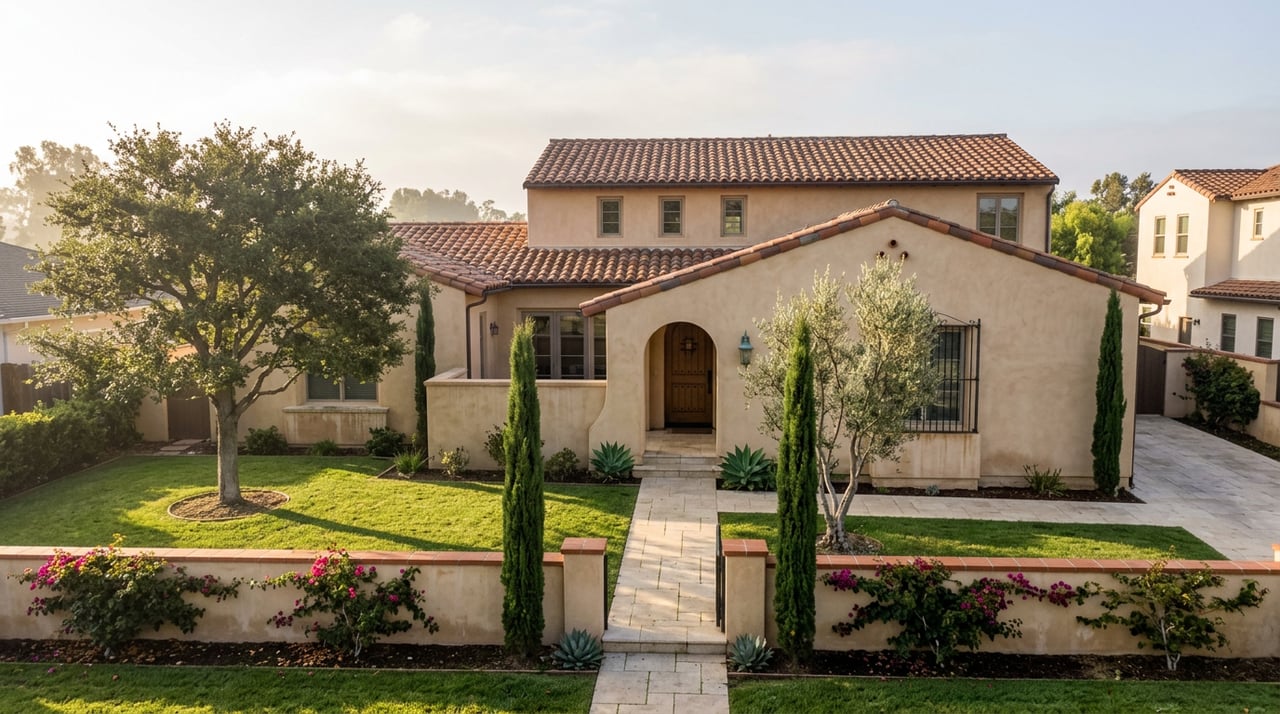
The first product hiding inside "South Corona" is a lifestyle bundle. Eagle Glen centers on a public 18-hole golf course that opened in 1999, with Spanish and Mediterranean-style homes built around it and its own elementary school and community parks inside the neighborhood. Dos Lagos is built around two constructed lakes on what used to be the site of the Temescal Tin Mines, anchored by the Shops at Dos Lagos retail center. Bedford, one of the newer gated villages, pairs modern farmhouse and Spanish-style homes with resort-style amenities at the Hudson House and The Shed, a 1.4-mile walking loop, and its own Bedford Marketplace for coffee and errands.
None of that comes free. Newer South Corona developments commonly sit inside Community Facilities Districts, which means Mello-Roos assessments layered on top of the base property tax, often adding somewhere in the range of $3,000 to $6,000 a year. HOA dues in communities like Dos Lagos, Sierra Del Oro, Eagle Glen, and Chase Ranch typically run $100 to $300 or more a month on top of that. Buyers moving in from Orange County sometimes miss this because their previous home had already paid off its Mello-Roos or never had one to begin with.
The second product is commute access, and it doesn't map cleanly onto the same footprint as the golf courses and lakes. Homes positioned west of Interstate 15 in Corona sit closest to the on-ramps for the 91 Express Lanes, the toll lanes that can cut peak-hour transit toward Orange County down to somewhere between 35 and 50 minutes for a toll that runs $3 to $12 depending on the time of day. That's a real, priceable advantage. But it's a function of where a specific address sits relative to the interchange, not a function of which HOA newsletter shows up in the mailbox.
The clearest proof that these are separate products: Horsethief Canyon Ranch. It's technically part of South Corona's broader Temescal Valley footprint, with Spanish Revival homes and mountain views, and many of its sections carry no Mello-Roos at all. It also trades on a 50-acre community park with walking trails that most HOA-governed neighborhoods would charge monthly fees to access. Yet homes in that broader area have been averaging 88 to 108 days on market, well past Corona's citywide average of roughly 44 to 54 days. It's priced like the affordable side of town and located like the resort side of town, and the market is telling you those two things don't automatically add up to a fast sale. It sells well specifically to the buyer who wants space and lower carrying costs over a shorter commute, and it sits longer with everyone else.
| What you're buying | Typical extra carrying cost | What it gets you | Time-on-market signal |
|---|---|---|---|
| Gated golf/lake resort (Eagle Glen, Dos Lagos, Bedford) | HOA dues $100–$300+/month, often plus Mello-Roos of $3,000–$6,000/year | Golf or lake frontage, gated streets, clubhouse amenities | Tends to move with the broader South Corona pace when priced to the amenity |
| Rural, fee-light (Horsethief Canyon Ranch) | Often none, confirm per address | Larger lots, community park access, mountain setting | 88–108 days, notably longer than the citywide average |
| Central/North Corona near downtown | Rarely any HOA or Mello-Roos | Older ranch-style homes, walkable historic core | Tracks the citywide average of roughly 44–54 days |
The On-Ramp Nobody Photographs
The commute math changed in a concrete way when the 15/91 Express Lanes Connector opened, a 2,406-foot bridge linking the eastbound 91 to the northbound 15 and the southbound 15 to the westbound 91 Express Lanes. Before that connector, drivers heading home to Norco, Jurupa Valley, and Eastvale had to exit the 91 Express Lanes and merge separately onto the 15. It was the Riverside County Transportation Commission's third toll project in six years, following the original 91 Express Lanes in 2017 and the 15 Express Lanes in 2021, funded through a mix of state funding and toll revenue.
The Orange County Transportation Authority describes the 91 Express Lanes as an 18-mile toll road running in the median of SR-91 between the SR-55/91 interchange and the SR-91/I-15 interchange, with an entry and exit point at the county line near Green River Road. What that means for a Corona buyer is simple: the commute advantage lives at that interchange, not at whichever half of the city a listing photo happens to label itself. A Central Corona home a short drive from that on-ramp can beat a golf-course home ten minutes further from it on any given weekday morning, regardless of which side of the city each one sits on.
What's Quietly Changing on the Cheaper Side of Town
While South Corona's HOAs have been building resort amenities for a decade, the historic downtown around Corona's Circle has been catching up. The city council adopted a plan to turn the Circle into a walkable downtown, and the first visible piece of it landed last year when Circle City Tavern opened as the first business inside The Hub, part of the newly renovated South Mall.
The next phase is bigger. The City Park Revitalization Project, aimed at the historic 20-acre park downtown, is now roughly 95% through design, with construction anticipated to begin in fall 2026. The plan includes a 70,000-square-foot community center with a gymnasium, banquet and conference space, and classrooms, plus a new aquatics center with a 10-lane competition pool, a recreation pool, a lazy river, and water slides. A few weeks ago, the city also opened a Downtown Innovation Center at the Corona Public Library near Main and Sixth, funded in part by a $2.5 million state grant, focused on workforce development and STEM programs for residents.
None of this touches South Corona's HOA structure or its Mello-Roos assessments. But it's the kind of public investment that has, in other Southern California cities, slowly narrowed the gap between a downtown core and its newer master-planned neighbors over the following years. Buyers weighing North or Central Corona against the South Corona premium are, in effect, betting on how far along that momentum gets before resale.
A Few Questions Worth Asking Before You Pay the Premium
- What is the actual combined Mello-Roos and HOA total for this specific address, not the community average, since assessments can vary by phase and section even within the same development.
- How many minutes does this address realistically add to reach the nearest 91 Express Lanes on-ramp during the 7 to 8 a.m. window, versus what a map estimate suggests.
- Am I paying for the gate, the golf course, or the freeway access, and do I actually need all three, or just one.
- If I'm looking at Central or North Corona, am I comfortable with construction activity and shifting parking near the Circle over the next year as the City Park and downtown projects move forward.
The city's median price was never built to answer any of these questions. It was built to give you a single number to start a conversation, not to end one.
If you're weighing a South Corona resort community against a North or Central Corona property closer to downtown's next chapter, The Alton Jones Team can walk through the actual carrying costs and commute math for a specific address, not just the neighborhood average. Explore more about buying in Corona or Schedule a Consultation to talk through what a particular property is really pricing in.